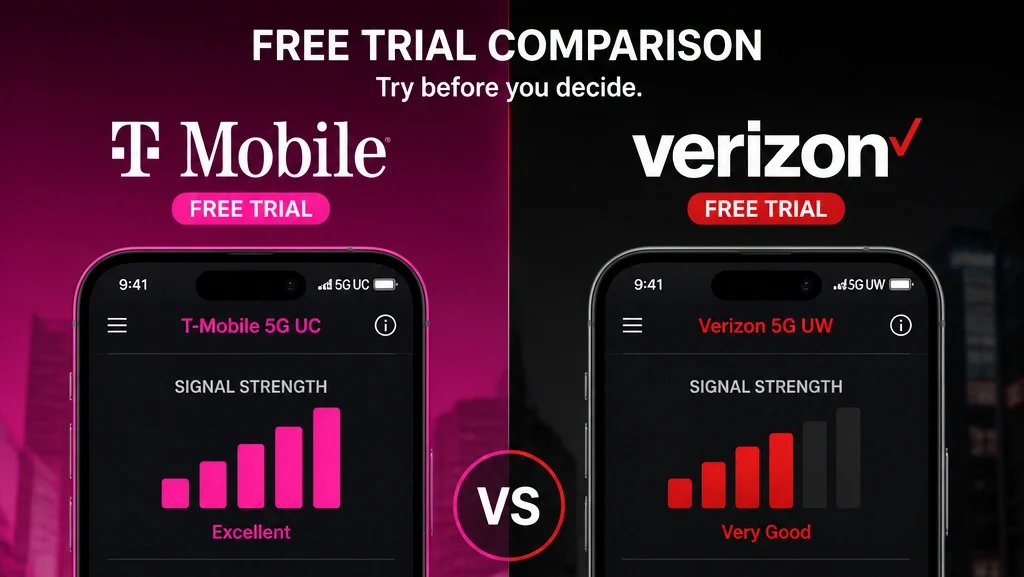
Free trials became genuinely useful once eSIM made it possible to run a test line alongside your existing service. You keep your number and your current plan, and the trial line rides on the same phone. That removes almost all the risk from evaluating a network — provided you test the right things.
How a trial actually works
You download an eSIM profile, which activates as a second line on your phone. Your original line keeps handling calls and texts on your existing number. The trial line gives you data on the new network, and you compare the two directly, in the same places, on the same device.
What you need
- An eSIM-capable phone that isn't carrier-locked. Locked devices generally can't add a competitor's eSIM.
- Dual-SIM support, so the trial runs alongside your existing line rather than replacing it.
- A few minutes to install the profile — usually a QR code or an in-app activation.
What trials do not cover
This is where expectations go wrong. Trials are data tests. They typically don't include your real phone number, so you're not testing voice quality on your own line, and they usually come with a modest data allowance rather than the plan's full terms.
- Trial data is often capped well below the plan you'd buy — enough to test coverage, not to replace your service.
- Because the trial line has a temporary number, you can't evaluate how your own calls and texts will behave after porting.
- Trial lines may sit at a different data priority than the paid plan, in either direction.
- Perks — streaming bundles, hotspot allowances, international roaming — are generally excluded.
How to run a trial that tells you something
- Test in the places you actually are: home, workplace, commute, and anywhere your current service is weak.
- Test indoors specifically, and on the lowest floor you spend time on. Indoor coverage is what low-band spectrum decides, and it's where networks differ most.
- Test at busy times as well as quiet ones. A network that's fast at 10am and unusable at 6pm has a congestion problem you'd live with.
- Compare directly: switch your data between the two lines in the same spot rather than relying on memory.
- Check upload as well as download, and note whether video calls hold up.
- Give it the full trial period. A single day tells you about one day's network conditions.
Watch the end date
Some trials convert to paid service automatically unless you cancel, and some ask for a payment method upfront. Note the exact end date when you start, set a reminder two days before, and confirm in writing what happens if you do nothing. This is the only part of a trial that can cost you money.
After the trial
If the network worked, you still have the switching sequence to run properly — porting your number, checking device credits, and timing the change around your billing cycle. The trial has answered the coverage question, which is the hardest one, but not the logistics.
All-in pricing across every plan we track, by network.
Compare phone plans →
Jean Gilles has researched personal finance, consumer technology, and wireless pricing for over a decade. He founded ShopCellPlans in 2019 and writes every review on the site.
Frequently asked questions
Do free trials require giving up my current plan? +
Can I keep my number during a trial? +
Will a trial cost me anything? +
Does my phone need to be unlocked? +
How long should I test for? +
One email when a carrier raises rates, drops a plan, or launches a deal worth switching for. No spam, unsubscribe anytime.