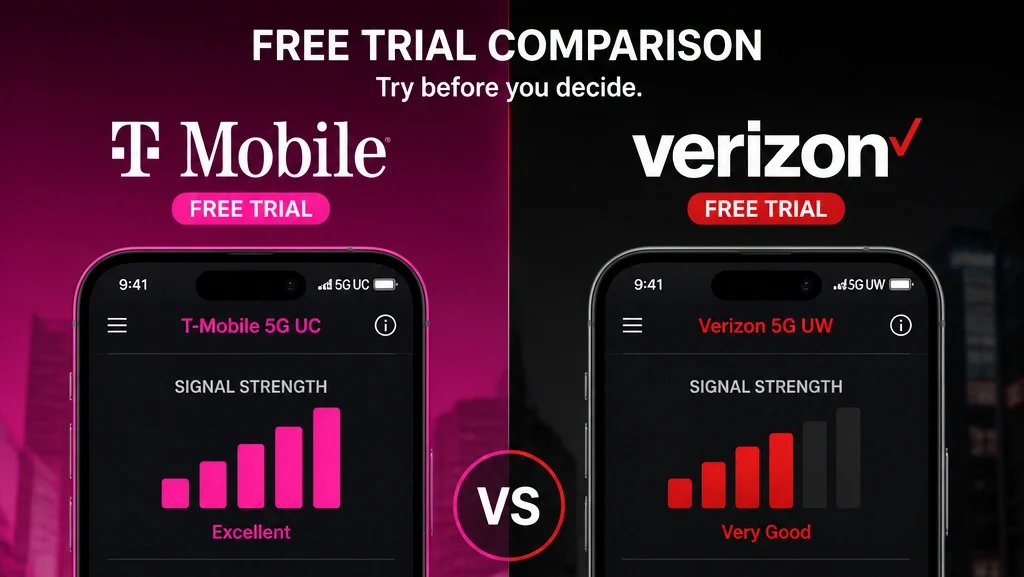
You did the smart thing: you signed up for a free cell phone trial. But simply using the new service for a month isn’t enough. To avoid switching carriers only to regret it six weeks later, you need a proactive plan — push the network until it breaks. This checklist breaks your 30-day trial into four focused weeks.
First: forget the signal bars
Bars are an unstandardized, simplified display — different phones calculate them differently, and they don’t tell you what you care about. Judge performance instead: do calls connect and hold? Do pages and maps load fast? Does video stream without buffering? A network showing three bars that never drops a call beats one showing five that stutters.
Week 1: your daily spots
- The dead zone test: take a video call in the spot where calls usually fail — basement, garage, back bedroom.
- Wi-Fi off test: kill home Wi-Fi — does the network stream 1080p without stopping?
- Peak commute data: speed-test around 8:30 AM and 5:30 PM on your busiest route.
- Office building test: deep inside, away from windows.
Week 2: capacity and features
- Stream at the highest quality in a crowded public spot — pausing means your trial line is being slowed.
- Time a 50MB+ upload/download against your old carrier; watch ping (under 50ms is good).
- Hotspot a laptop for an hour; check the allowance used.
- Wi-Fi calling: airplane mode + Wi-Fi call, then test the handoff to cellular.
Week 3: travel and value
Drive 20–30 miles out of your usual area, watch the connection on a long highway drive (does it drop to 3G/E?), and test a busy mall on a weekend. If the trial includes perks — T-Mobile Tuesdays, in-flight Wi-Fi, satellite — use them to gauge the paid plan’s real value.
Week 4: decide
Review your notes — repeated drops and dead zones across weeks are the warning sign, not one bad speed test. Confirm the paid plan actually includes the features you tested. Check how the trial ends: most eSIM trials (Verizon, T-Mobile) expire automatically; some (US Mobile) auto-renew into a paid plan. If switching, start ~24 hours before the trial ends with your account number and transfer PIN ready.

Jean Gilles has researched personal finance, consumer technology, and wireless pricing for over a decade. He founded ShopCellPlans in 2019 and writes every review on the site.
Frequently asked questions
How do I stress-test a carrier trial? +
Why not trust signal bars? +
When should I test? +
What happens when the trial ends? +
One email when a carrier raises rates, drops a plan, or launches a deal worth switching for. No spam, unsubscribe anytime.