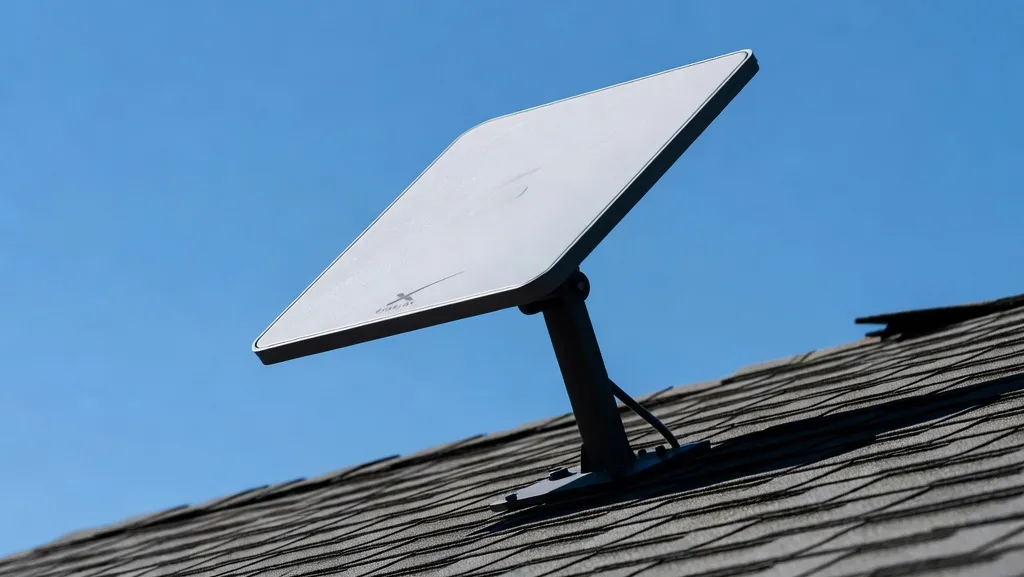
Phone-and-internet bundles from the big three all share one blind spot: the internet half is 5G fixed wireless, which needs a strong cellular signal at your house. If you're rural, in the mountains, on a worksite, or living in an RV, that's precisely the thing you don't have. US Mobile pairing its cellular plans with Starlink is the only bundle in the category built for those addresses — and that, not the price, is the reason to look at it.
What's in the bundle
- Unlimited Starter + Starlink — from $72/mo. Unlimited high-speed data, talk and text with hotspot on any of the three major networks; international roaming is an add-on.
- Unlimited Premium + Starlink — from $80/mo. Unlimited priority data, talk and text with hotspot, plus international roaming included.
- The Starlink side advertises speeds up to 400+ Mbps, with Residential and Roam plans available.
The cellular half is the part worth understanding. US Mobile lets you pick Verizon, AT&T or T-Mobile at signup and transfer between them, so a rural line can sit on whichever network actually reaches the property. That's a genuinely different proposition from a Verizon or T-Mobile bundle, where the phone and the internet are both tied to one network's footprint.
Why this bundle exists and the others don't work
T-Mobile Home Internet, Verizon 5G Home and AT&T Internet Air are all fixed wireless: a receiver in your window pulling the same cellular signal your phone uses. Where that signal is strong they're excellent value. Where it isn't, they're either unavailable at your address or slow enough to be frustrating — and the coverage gaps are the rural, mountainous and low-density areas where wired broadband didn't reach either.
Satellite doesn't care about tower distance. That makes this the only bundle on the market aimed at the household that has been told "not available at your address" by everyone else.
What the bundle implies about the internet price
You can back out the internet component from US Mobile's own pricing. Unlimited Premium runs $32.50/mo on annual prepay, so a $80 bundle puts the Starlink share around $47.50. Unlimited Starter at $22.50/mo against a $72 bundle implies about $49.50. The two line up, which suggests the satellite half is priced near $48–$50/mo inside the bundle.
That's the number to compare against Starlink's standalone residential pricing in your area. If standalone is meaningfully higher, the bundle is doing real work. If it's close, you're paying for a single bill rather than a discount — which is fine, but worth knowing before you sign up.
How it compares to the 5G bundles
On price, the fixed-wireless bundles win where they're available: T-Mobile, Verizon and AT&T all discount home internet heavily when you have a phone line with them, and their internet tiers commonly land well below $50/mo bundled. On reach, they don't compete at all — and on the phone side, none of them offer a choice of network.
- Choose a 5G bundle if fixed wireless is available and tests well at your address. It's the cheaper answer.
- Choose US Mobile + Starlink if fixed wireless is unavailable, unreliable, or you move around.
- Choose US Mobile + Starlink Roam specifically if the internet needs to travel with you.
- Keep them separate if you want to change either half independently without renegotiating both.
The RV and worksite case
This is the configuration with no real competitor. Starlink Roam plus a multi-network cellular line covers the two failure modes of mobile living: no signal at the campsite, and a single carrier's dead zone along the route. Because US Mobile lets you move the line between Verizon, AT&T and T-Mobile, you can match the phone to the region you're in while satellite handles the data at a standstill.
The trade-offs are real — satellite needs a clear view of the sky, performance drops under heavy tree cover, and the hardware is one more thing to mount and stow. But for full-timers, it's the difference between working remotely and driving into town for Wi-Fi.
Before you commit
- Check whether 5G home internet is actually available at your address first. If it is and it tests well, it's the cheaper route.
- Confirm the current bundle price and exactly which Starlink plan is included — Residential and Roam are not interchangeable.
- Get the hardware cost in writing, including whether it's bought or leased.
- Pick the cellular network deliberately: check which of the three covers your property before signing up, not after.
- Confirm whether international roaming is included on your tier — it is on Premium, an add-on on Starter.
- Test the cellular side with a trial if you can, so you're only committing to the satellite half blind.
The verdict
Judged as a discount, this bundle is unremarkable — the implied internet cost is close to standalone satellite pricing, and any available 5G home internet bundle will beat it on price. Judged as a solution, it's the only one of its kind: a single bill covering a phone line that can sit on any of the three major networks and an internet connection that works where none of those networks reach a house. If you're in one of those places, that's not a marketing angle, it's the whole point.
See how Starter and Premium score before you bundle anything.
US Mobile plans and pricing →
Jean Gilles has researched personal finance, consumer technology, and wireless pricing for over a decade. He founded ShopCellPlans in 2019 and writes every review on the site.
Frequently asked questions
How much is the US Mobile Starlink bundle? +
What's the difference between the two tiers? +
Is the bundle cheaper than buying separately? +
Does it include the Starlink hardware? +
Which cellular network do I get? +
Is this better than T-Mobile or Verizon home internet bundles? +
Can I use it in an RV? +
Does satellite internet work everywhere? +
Can I cancel one half of the bundle? +
One email when a carrier raises rates, drops a plan, or launches a deal worth switching for. No spam, unsubscribe anytime.